How to Find Your Coaching Niche When Every Option Fits
By Dorian Matney
You have range, and your referrals already buy. The open question is which single signal strangers should see first. This guide walks through the mechanism I use to read a niche from your own client history, with the real numbers from clients who did it.
How do you find your coaching niche?
You find your coaching niche by reading two signals in your own client history: which clients got your best results, and which clients gave you energy instead of draining it. Cross those two lists and your lane appears. The niche is a recognition, not a decision. After one brand refinement named Diamond's niche and let one signal lead, she reached $12,000 in 14 days.
Most niche advice hands you a menu and asks you to choose. The two read signals work the other way around. They look at what has already happened in your practice and show you the pattern that was there all along. This is the actual mechanism, and it has been tested for decades.
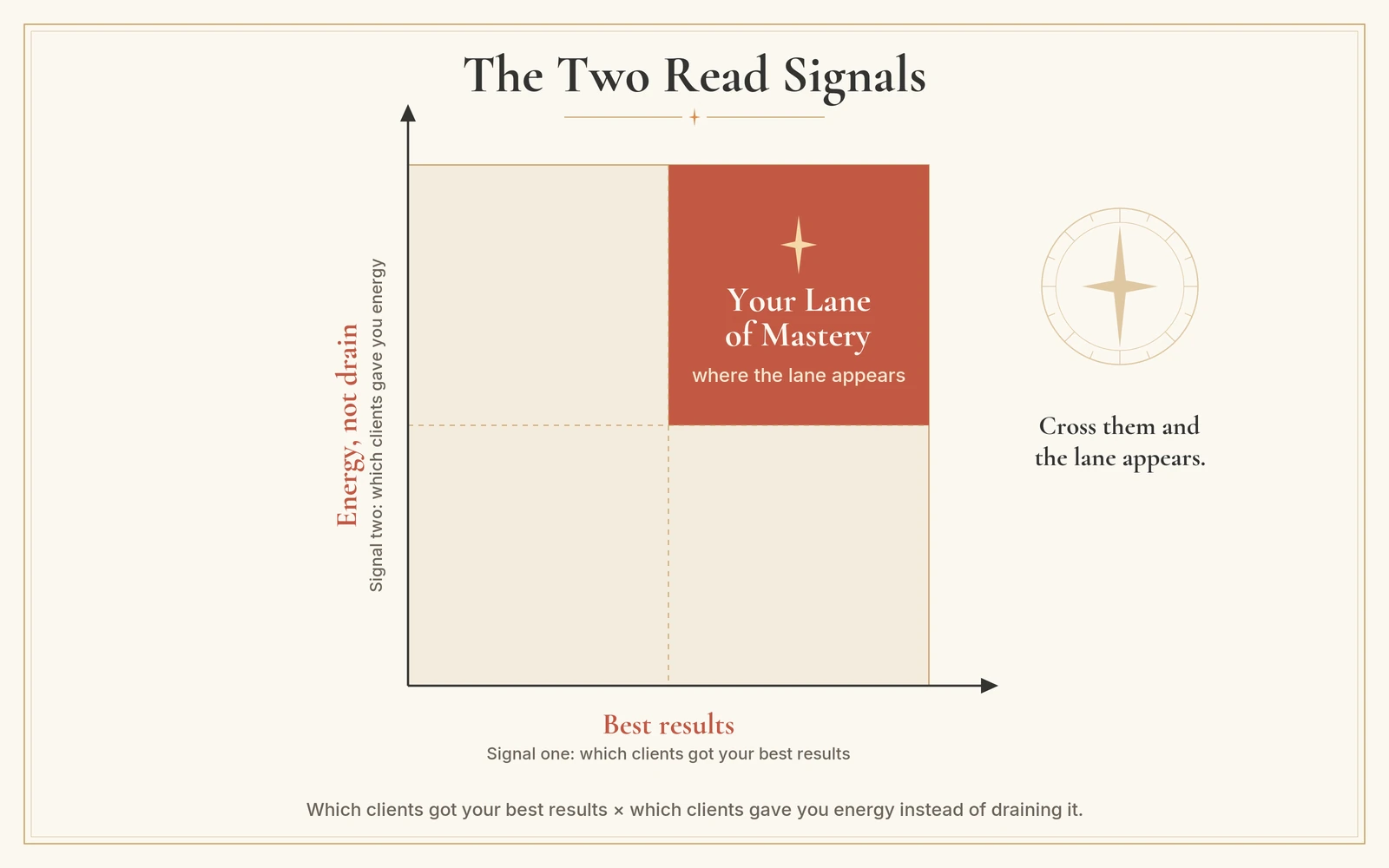
The two read signals are which clients got your best results and which clients gave you energy instead of draining it; cross them and the lane appears.
Here is how to run the read yourself:
- Signal one: best results. Write down the clients who got your best results.
- Signal two: energy. Write down the clients who gave you energy instead of draining it.
- Cross them. The clients who show up on both lists point to your Lane of Mastery, which is the place where your expertise, a real market need, and what lights you up intersect.
If your two lists blur together, that is not failure; that is the multi-gifted pattern. The lane can't be seen from inside it. That is what a read from outside is for, and it is exactly what Which Niche™ does: about an hour with Xero, and your niche is named.
"Niche" sounds like shrinking. "Lane of Mastery" sounds like arriving. Both describe the same thing: the one place where your best work and your best energy already meet.
That is why I call the niche a recognition, not a decision. It already exists in your pattern. You are not inventing it, and you are not picking it off a list. As I put it: "You don't choose a niche. You SEE it, from the right position."
Diamond is the clearest example of what changes when the niche is seen. Before, she was posting daily on 3 platforms, mailing flyers, and printing promotional pens, and she was under $1,000/month. After one brand refinement (the niche named, one signal led), she reached $12,000 in 14 days. She did not get more talented in two weeks; strangers could finally see her.
What should my niche be?
Your niche should be your Lane of Mastery: the place where your expertise, a real market need, and what lights you up intersect. It already exists in your pattern, so the job is to see it, not to invent it. Amy was buried in the wrong niche. Once she was re-aimed at the right one, she reached $12,500 in her first 30 days.
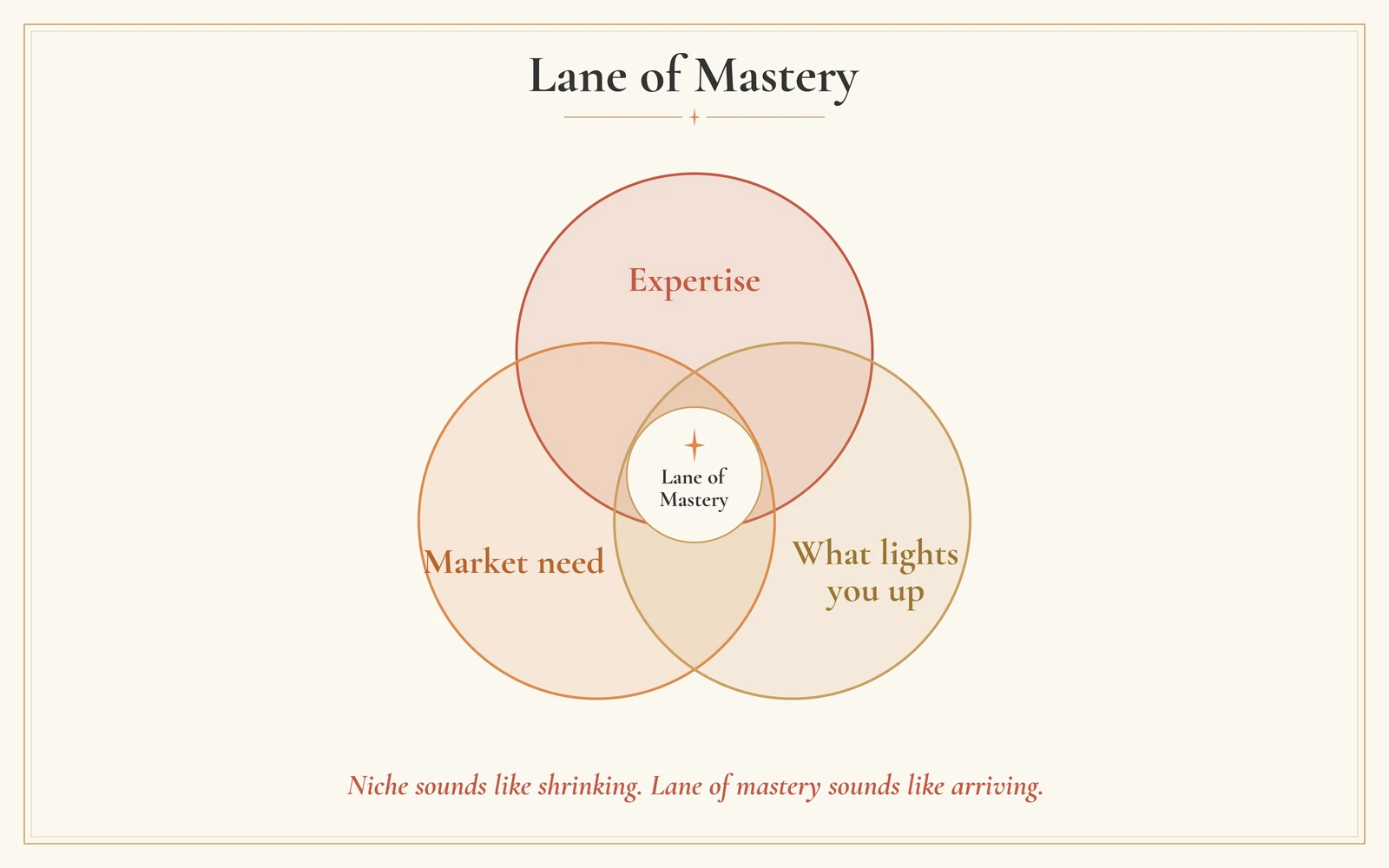
Lane of Mastery is where your expertise, market need, and what lights you up intersect.
If you have been asking "what should my niche be" for months, the question itself may be part of the snag. A decision question invites a list of options, and a list of options invites more debate. A recognition question asks something different: what is already true in your results and your energy?
That is the shift. You stop asking which niche you could defend and start asking which clients you have already served best, with the most energy. The answer to that question is not a guess. It is in your history.
Amy's re-aim moved fast: $7,500 in the first 7 days; $12,500 by day 30.
Why do niche quizzes and worksheets fail multi-gifted coaches?
Quizzes and worksheets fail multi-gifted coaches because every option passes. If every option survives the worksheet, the worksheet is the wrong tool. One 30-year artist worked in endless mediums (metals, resins) with no stability, and every niche passed every worksheet. I read her in about 3 minutes. Her niche was in her pattern, not her logic.
A worksheet scores options against your logic. If you are genuinely good at several things, you score well everywhere, and you walk away with a longer list instead of an answer. Your range is real. It is not the problem. The tool is the problem.
Here is what the read looked like with the artist. Every niche passed every worksheet, so the worksheets could never separate them. I read her in about 3 minutes. The question was: "Where does your passion live?"
Her answer: "A HERD OF HORSES."
No worksheet would have produced that line, because it was not sitting in her list of options. It was sitting in her pattern. That is the difference between choosing a niche and seeing one.
Is there a better alternative to a find your niche quiz?
Yes: a read instead of a quiz. Which Niche™ is a guided conversation with Xero, about an hour, in 3 steps. She names your niche and builds your Lane Map, the document your marketing grows from. No worksheets; she reads you. Xero is trained on my approach to guiding people into their highest path of potential, which is why she can align your positioning the way I would: the read is the same gift.
A quiz asks you to pick from options someone else wrote. A read starts from you.
| Find your niche quiz or worksheet | A read (Which Niche™) | |
|---|---|---|
| Starting point | A list of options | Your own pattern |
| What it looks at | Which options you can defend | Your best results crossed with your energy |
| When every option fits | Every option passes, so you stay stuck | It looks past the options to your pattern |
| What you leave with | A label or a longer list | Your niche named and your Lane Map built |

Want your niche read instead of quizzed? Which Niche™ is $29. In about an hour with Xero, your niche is named and your Lane Map is built.
How do I pick a niche for my coaching business without leaving anyone out?
Wanting to leave no one out is your heart talking, and that is a feature, not a flaw. Keep it. The niche is the front door, not the whole house: it only changes what new people see first, and nobody you currently help gets turned away. Allen E. specialized his brand, rebuilt his packages, and added the sales method. The work itself did not change.
If "I don't want to leave anyone out" is the thing stopping you, you are in good company. That instinct is why your current clients trust you. Nothing about picking a niche asks you to give it up.
Here is what the front door actually does. A sharper front door means more strangers walk in, which means more people helped, not fewer. The people already inside the house stay inside the house. Invisible helps no one.
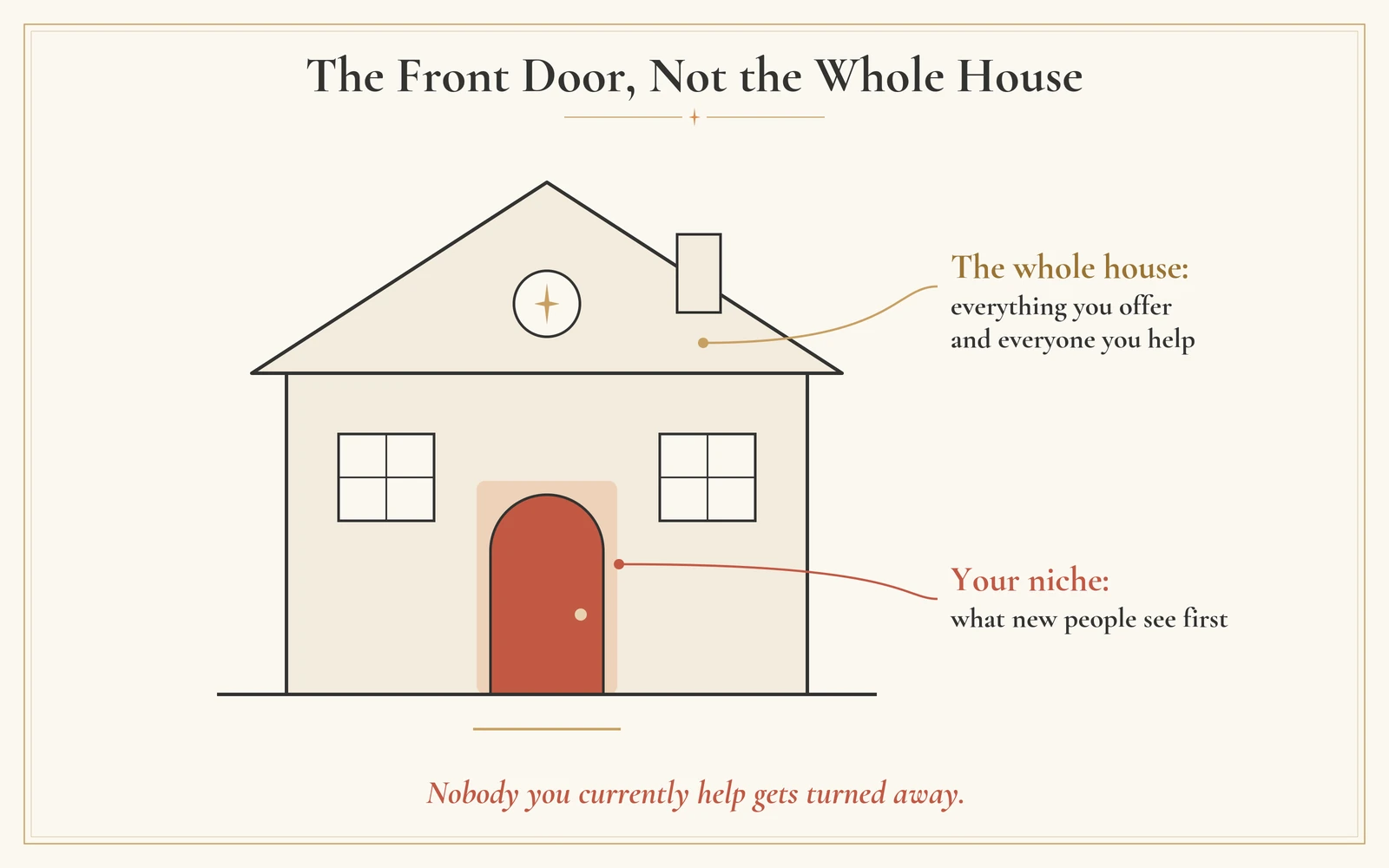
The front door is your niche: it only changes what new people see first, and nobody you currently help gets turned away.
Allen E. is the proof that the work does not have to change. Before, he made about $7,000 per year from personal training. He came with craft skill but not business, marketing, or sales. He did three things with me: (1) specialized his brand, (2) rebuilt his packages, and (3) added the sales method. Here is what he wrote, word for word:
"Now I have a solid 30-40 paying clients from online and made about $7,800. Due to a lot of paid in full sign-ups."
That $7,800 month beat his entire previous year. The work itself did not change: same personal training. And "paid in full sign-ups" is the sales method's fingerprint appearing unprompted.
Why do referrals buy from me when strangers don't?
Range is real, and it works with people who already trust you. Strangers need one sharp signal, because seven signals cancel out. Riserr, the performance marketing agency I founded in 2008, generated over $1B for clients, split evenly between marketing (getting people from stranger to lead) and sales (lead to customer).
This is the part most niche advice skips. Your referrals arrive pre-sold. Someone they trust already vouched for you, so your range reads as depth. A stranger has no voucher. To a stranger, a jack-of-all-trades reads as master-of-none, not because it is true, but because trust needs one sharp signal and seven signals cancel out.
So here is what a niche for coaches actually is: a marketing instrument. Marketing needs the niche. You don't. Your practice doesn't. Your MARKETING does.
A few lines I come back to often:
- "Generalists get paid. Specialists get rich."
- "A specialized brand commands higher prices, and prospects EXPECT to pay them."
- "Known, not guessed."
What happens after you find your coaching niche?
Once your niche is named, the vortex starts: a loop that feeds itself the same fuel it produces. Lane clients bring out your best work, your best work produces results, and results bring testimonials and referrals in the same lane, which bring more lane clients. The natural next step is Your Flagship Offer™, which turns the niche into a $2,000 to $10,000 packaged transformation.
The niche is complete on its own: it tells strangers who you are for. Each next step builds on what the step before it produced.
Next step: package the transformation. Sessions have no finish line, so clients drift and there is nothing to charge real money for. A package is the transformation with a start, an end, and a destination. The package IS the transformation, not the hours. Price comes only after the package exists. That is what Your Flagship Offer™ builds: one page, titled with your name.

Why packages matter: clients who invest more get better results. Period. "A $5,000 client finishes. A $50 session drifts."
Next step: the sales conversation. Standing Ovation Sales™ is the method named by the people who watched it. Presence, not pressure. Five movements, your script in your voice.

Your next step. If every option still passes every worksheet, stop choosing and get read. Which Niche™ is $29: a guided conversation with Xero, about an hour, that names your niche and builds your Lane Map, the document your marketing grows from.